
Herbal Thursday: Neem
Neem Oil for Summer: A close look at Azadirachta indica, its active compound azadirachtin, and the real difference between a garden spray and a medicine cabinet staple.
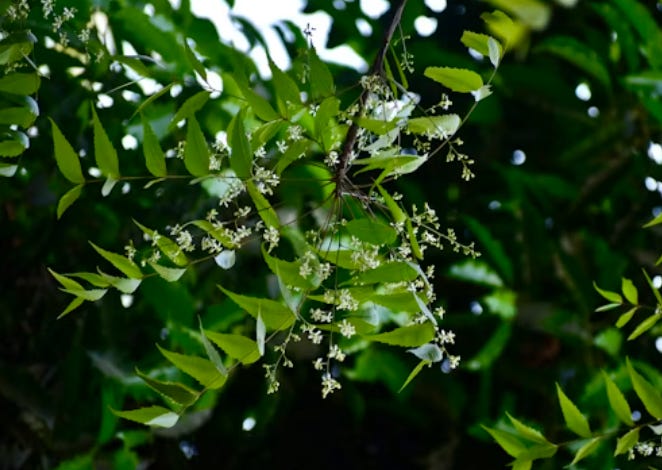
To The Point:
Bug bites and aphid-chewed tomato leaves both peak in July, and neem tackles both. This bitter, fast-growing tree (Azadirachta indica) has earned a spot in Ayurvedic medicine for thousands of years, thanks to compounds like azadirachtin that pack a real punch against insects and microbes. Rub diluted neem oil on your skin, and it repels mosquitoes. Spray it on your garden, and it knocks back aphids and fungal pests. Brush your teeth with it, and it may calm inflamed gums. However, don’t swallow concentrated neem oil, especially if you give it to a child, as you risk real harm — so keep reading before you reach for a bottle and consider neem powder instead. (1)
What Is Neem?
If there is one plant I never stop talking about, it’s neem.
Neem, an evergreen tree in the mahogany family (Meliaceae), is native to India and Myanmar and now naturalized across South Asia, West Africa, and parts of the Caribbean and Central America. Traditional systems use nearly every part of the tree — leaf, bark, seed, flower, and root — which is part of why it holds such importance in Ayurvedic medicine, as well as in permaculture and natural-farming circles today.
Neem is one of the most powerful medicinal trees on Earth. For thousands of years, people have turned to this incredible plant for healing, cleansing, protection, and renewal. Every time I work with neem, I’m reminded that Nature already provides so many of the answers we’ve been searching for.
The more I learn about neem, the more respect I have for it. This isn’t just another herb. It’s an entire pharmacy growing on a tree.
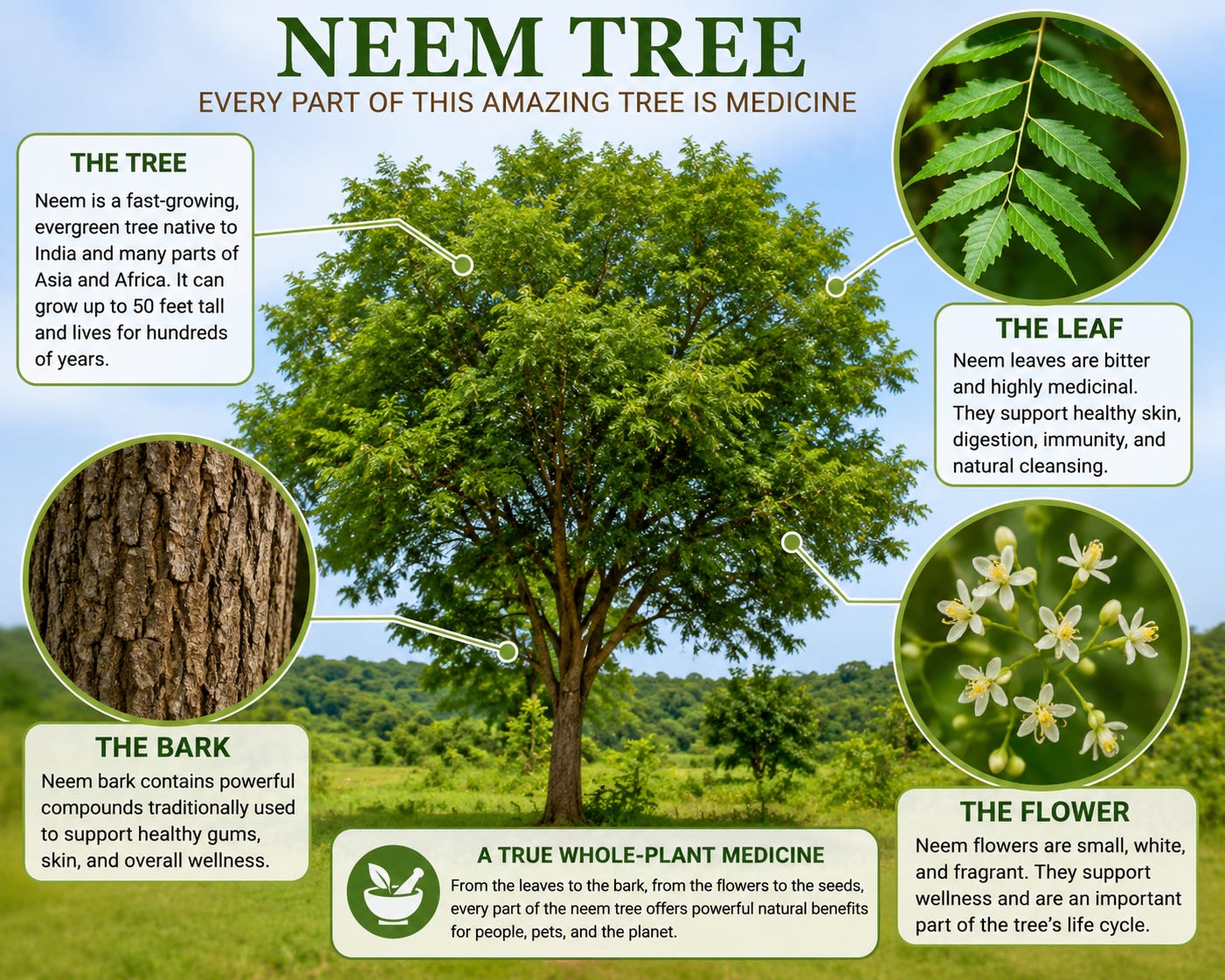
The Whole Tree Is Medicine
One of the things I love most about neem is that nearly every part of the tree has a purpose. The leaves, bark, flowers, seeds, and oil each offer unique benefits. Nature wastes nothing.
Fresh neem leaves have an intensely bitter taste. Most people don’t love that flavor at first — and that’s okay! The bitterness tells you something important. Bitter plants have always played a powerful role in traditional wellness practices. As you’ll see, though, modern research has focused much more narrowly on a handful of specific applications.
This post is free thanks to the support of our paid subscribers. Please consider becoming a free or paid subscriber to keep this content available to the public.
Does Neem Actually Repel Mosquitoes and Bugs?
This question matters most right now, and the evidence genuinely delivers.
Gardeners around the world have used neem oil for generations to protect fruits, vegetables, herbs, and flowers. It supports healthy gardens while working in harmony with Nature.
Mosquitoes:
Researchers have studied neem oil’s insect-fighting compounds — azadirachtin most of all — for decades. Lab and field studies on Aedes, Anopheles, and Culex mosquitoes show real repellent and larva-killing power. Field trials found that 2% neem oil mixed with coconut oil gave 96–100% protection from anopheline mosquitoes and 85% protection from Aedes over several hours. (2)
A separate village-based trial found 81% to 91% protection over a 12-hour period.
A malaria-endemic field trial in Ethiopia comparing neem oil to DEET found neem cut mosquito bites by roughly 70% over four hours, while DEET stayed more effective but increased toxicity, especially in kids. More recently in Italy, neem oil’s repellent effect worked best indoors and during the hottest, driest months of summer. (3)
I use Second Skin Hawaiian Jungle Shield, which contains Neem and is an excellent insect repellent.
Garden pests:
That same azadirachtin compound that repels mosquitoes also disrupts insect growth and feeding in other insects. It throws off molting, metabolism, and even reproduction in a wide range of species. Field studies in Ethiopia found neem seed extract sprays significantly cut fall armyworm damage in maize and boosted yields by 24% to 67% over unsprayed plots. (4)
Lab studies confirm neem leaf and seed extracts kill a large share of fall armyworm larvae outright. In Ghana specifically, neem seed oil biopesticides worked as well as synthetic insecticides against the same pest. (5, 6)
My own garden practice echoes this research closely. Yet I prefer using neem tea for spraying on my plants (over neem oil combined with soap, which is the norm). Neem tea spray works better and disburses particularly well.
Pro Tip: Brew neem into compost teas alongside tulsi, horsetail, and medicinal mushrooms to make an all-purpose plant-health spray. This knocks back aphids and frees stressed, fungus-burdened trees to grow again
Plant pathologists call this dynamic disease-pressure relief — strip away the fungal or microbial burden, and the plant’s own growth takes back over.
Bottom line for gardeners:
Grab diluted neem oil (follow the label) for both personal bug protection this summer and pest or fungal control in your vegetable patch. The research backs you up on both fronts.
Traditional and Emerging Uses
1. Oral and Gum Health
One of my favorite uses for neem is oral care. Long before modern toothpaste existed, people chewed neem twigs to clean their teeth and strengthen their gums. That ancient wisdom still inspires me today.
It has also inspired some scientific research. A randomized, double-blind clinical trial found that a neem-containing toothpaste significantly improved plaque and gum-inflammation scores compared to a control group. This lines up with centuries of tradition: people across South Asia have chewed neem twigs as toothbrushes for generations. (7)
If your gums need extra attention, fresh neem leaves can even be crushed into a simple poultice and applied directly to the gums. It's one of those timeless practices that reminds us how connected we once were to the natural world.
Did you see the article on oil pulling? You can add neem oil to that process — just be careful not to swallow! You can also make your own neem toothpaste: using coconut oil as a carrier and antimicrobial, add activated charcoal and powdered neem leaf. Powdered Neem leaf, as it isn’t as concentrated as the oil, is safer for brushing.
2. Skin Conditions
Neem oil supports healthy skin. It nourishes dry areas. It helps soothe irritated skin. Many people have traditionally used it for common skin challenges. Nature has an amazing ability to restore balance when we give it the chance.
Ayurvedic dermatology has long turned to neem’s antimicrobial and anti-inflammatory compounds for acne, eczema, and psoriasis-related irritation, usually diluted in a carrier oil like coconut oil. Modern dermatology reviews call this a promising but under-researched area. While the mechanism makes sense and traditional use provides evidence, rigorous human trials for chronic skin conditions remain scarce. (8)
One caution worth noting: neem oil packs real strength and can irritate sensitive skin, so patch-test it first or, better yet, swap the oil for neem tea. And if a difficult skin condition lingers or worsens, consider discussing it with a holistic dermatologist.
Yet topical use of neem oil stays low-risk for most healthy adults. Dilute it in a carrier oil, put it on your skin or gums, or pull oil with it. As long as you don’t swallow it, expect nothing worse than occasional skin irritation. (9)
A Note of Caution
Reported Reproductive Effects
What performs so effectively against insects may be effective against humans, too. To wit, researchers have studied neem oil and seed extracts as a candidate for topical contraceptive and spermicide since the 1960s, including a neem oil fraction called NIM-76 that immobilizes human sperm within seconds in lab studies. (10, 11) Separate research has tested neem oil as a male contraceptive as well, finding it blocks sperm production in animal studies. (12)
That’s real impact on the reproductive process, so it’s best to avoid neem, especially neem oil and extracts, if you’re trying to conceive.
Safety: What the Research Says You Need to Know About Neem Oil
Swallowing neem oil provides a cautionary tale, and the medical literature doesn’t sugarcoat it. Case reports from India and Southeast Asia — where caregivers have traditionally given neem oil to infants and children for minor ailments — describe severe metabolic acidosis, seizures, liver and kidney damage, and a Reye’s-syndrome-like crisis after oral ingestion. (13)
Some infants developed these symptoms from doses as small as a teaspoon, and imaging studies have documented the neurological damage that can follow even in adults. Several cases ended in death. This pattern shows up consistently across peer-reviewed case reports and toxicology reviews spanning decades, so it’s far from a fringe finding. (14)
Because of this, dermatology and toxicology reviews land on the same clear points: (9)
Never give neem oil or leaf internally to a child under 12, and never use it to treat a child’s fever. Its aspirin-like compounds carry the same documented Reye’s-syndrome risk as aspirin.
Skip internal use during pregnancy and breastfeeding.
Skip internal use if you’re trying to conceive — the reproductive research above makes this a real consideration, not just caution for caution’s sake.
Use extra care if you take blood-sugar-lowering medication, since neem can independently drop your blood sugar.
None of this touches a garden spray, a diluted skin oil, or oil pulling that never gets swallowed. It targets one specific behavior: drinking neem oil or giving it to kids.
If you take one thing from this article, let it be this: lean on neem for mosquito repellent and garden spray duty this summer. For oral health, neem powder is the better way to go, and neem tea carries a safer profile.

How to Use Neem This Bug Season
As a personal repellent: dilute a small amount of neem oil into a carrier oil (coconut oil is the traditional, well-studied pairing) and apply it to exposed skin. It works especially well in enclosed outdoor spaces like patios and screened porches.
As a garden spray: dilute neem oil and spray your plants in early morning or evening, when pollinators stay less active, to knock back aphids and other soft-bodied pests along with some fungal issues.
When you buy it: choose cold-pressed neem oil that lists its azadirachtin content on the label. Quality swings widely between commercial sources, so check before you buy. Cold-pressed neem oil is exempt from U.S. EPA pesticide residue limits on food crops, which reflects its long safety record as a topical, non-ingested agricultural product. (15)
Can you eat neem leaves? Traditional practice includes chewing raw neem leaves, and Ayurvedic and permaculture circles commonly recommend it. That said, the medical safety concerns center on concentrated neem oil, not fresh leaf, and they matter most for children, pregnant or breastfeeding people, and anyone trying to conceive. If you fall into one of those groups, avoid internal neem use in any form. (9)
Conclusion
I believe true wellness isn’t about attacking symptoms. It’s about creating an environment where the body can thrive. Neem fits beautifully into that philosophy.
Some of the world’s greatest health discoveries happened thousands of years ago.
Neem has stood the test of time because it works within Nature’s design. Generation after generation has trusted this remarkable tree, and its reputation continues to grow because people keep experiencing its benefits firsthand.
This article is for educational purposes and is not a substitute for medical advice. If you are pregnant, breastfeeding, trying to conceive, or considering neem for a child, talk to a healthcare provider first.
These statements have not been evaluated by the Food and Drug Administration. This information is not intended to diagnose, treat, cure, or prevent any disease.

We’re getting ready for David Avocado Wolfe’s 4th Health & Rejuvenation Conference, and we’d love to have you join us!
David Wolfe’s Health & Rejuvenation Conference DECEMBER 4 & 5, 2026
Featuring: David Avocado Wolfe and Special Guests at a beyond beautiful Private Texas Ranch.
We will cover a vast array of subjects at the Conference:
Detox & Cleansing: Cleansing, Fasting, & Detox for All Ages; Nicotine, Parasites, & Nanotech Protocols; Charcoal, Activated Charcoal, & C60.
Immunity & Performance: Creating a Host Defense/Mega Immunity (Mushrooms, Superherbs, & Electronic Medicine); Peak Performance & Superfoods; Jing Energy.
Farming & Soil: Foraging & Farming; Soil: The Ecstatic Skin of the Earth.
Self-Governance & Strategy: United Non-Compliance & Selecting Out of Big Brother Systems.
Mindset & Philosophy: Activating Genius (The Power of Intention); Navigational Philosophies (Rudolf Steiner, Charles Fort, Book of Revelation); The Best Day Ever & More!
Join the David Avocado Wolfe Substack Community
This is where transformation begins — are you ready to join us?
Wolfe University
Ready to go all-in? Experience the new Wolfe University with both free and paid courses, as well as the platform for David Wolfe's Inner Circle.
Are you new here? Opt-in for my weekly newsletters and gain access to your first course — on me! Click Here: https://wolfeuniversity.kit.com/free-course
David Avocado Wolfe Links
David Wolfe Website: https://www.davidwolfe.com/
Wolfe University: https://university.davidwolfe.com/
David Wolfe Shops
Australia: https://davidwolfe.com.au/
Canada: https://www.wildavalon.ca/
Chocolate: Our favorite Chocolate Factory is now located in Central Florida! Please visit Butler’s Raw Chocolates! 2400 South Hopkins Avenue, Unit E, Titusville, FL 32780
Butler’s Raw Chocolates: https://butlersrawchocolates.com/
Links on this page may include affiliate links; any commissions earned are at no extra cost to you and support the continuing work of David Avocado Wolfe.
This Substack post may have been created with the aid of AI.