
Herbal Thursday: Thyme
Thyme in the Kitchen: Discover how this fragrant garden favorite supports the body's natural defenses, calms coughs, and brightens your winter table.

Parsley, Sage, Rosemary and … Thyme.
As the holiday season approaches, it’s time to get out the cookbooks and pick the last of the herb harvest from your garden or windowsill — or maybe pick up some herbs from your local farmer’s market.
If you’re lucky, maybe you have an indoor garden tower, where you can grow and harvest herbs year-round!
Thyme has historical value in addition to its culinary and health benefits. As one of the herbs brought from the Old Country, English Thyme, in particular, still graces the gardens of historic Colonial Williamsburg in Virginia. And though Thomas Jefferson called thyme an object for the garden, ancient Assyrians likewise grew this herb. (1)
While herbs like rosemary and thyme and sage recall Thanksgiving Days past, these herbs also come with amazing health benefits. Like the humble dandelion in the summer, tiny thyme packs a health punch.
In fact, culinary herbs — including thyme from your garden — rank high for antioxidant content compared to many everyday foods, so even small culinary amounts can “nudge” your daily antioxidant intake upward.
Like rosemary, however, thyme essential oil dominates the scientific research. While you can find benefits from using fresh and dried thyme in your kitchen creations, you can also add thyme essential oil to your soups, bath bombs, cough drops, and more.
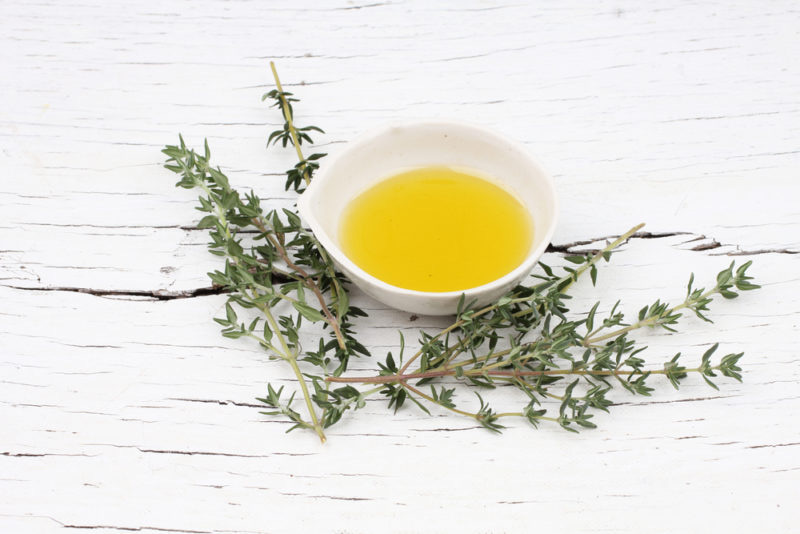
Thyme Health Benefits
1. Antioxidant Capacity
Antioxidants help neutralize free radicals — unstable molecules in the body that can damage cells and lead to aging or chronic disease. The antioxidant potential of foods is so valuable that the National Institute on Aging (NIA) created the ORAC unit of measurement. Foods and supplements are cataloged in ORAC units — a measurement of their antioxidant capacity, based on 100 grams of that item.
Of course, you won’t sit down and eat 100 grams of fresh thyme, but its high value indicates that fresh thyme is an herb with a high antioxidant level compared to other fresh herbs. In fact, thyme contains many antioxidant compounds, including the active ingredients, thymol and carvacrol, plus flavonoids, phenolic acids and other plant molecules.
For everyday use, the culinary herb gives a boost. Sure, fresh herbs won’t match high-dose extracts. Yet using fresh or dried thyme in meals adds antioxidant value. It’s part of a broad healthy diet.
2. Antimicrobial & Anti-Infection Support
As we know, we share this world with microbes — the good, the bad, and the ugly. The antimicrobial activity of thyme means the herb can inhibit or kill some of these microbes.
Specifically, thyme essential oil is a natural antiseptic, thanks to its compounds caryophyllene and camphene. These compounds kill microbes on the skin and inside the body to protect wounds and sores from infection.
Likewise, thyme essential oil also has antibacterial properties. For example, a study conducted at the Medical University of Lodz in Poland found that thyme essential oil exhibited extremely strong activity against 120 different strains of bacteria.
Furthermore, the thymol and carvacrol in thyme are among the compounds showing antimicrobial power. For example, thyme oil rich in thymol inhibited growth of Staph. aureus and E. coli. Thyme compounds can disrupt bacterial membranes, prevent biofilms, etc.
Also, review articles show that thyme extracts aid in food preservation because of these properties.

3. Respiratory Health: Curbs Cough & Bronchitis
After the past several years, common upper respiratory infections caused heightened concern for many people. So immune health support means helping breathing, reducing cough, and easing bronchial irritation.
Historically, thyme has been used as an expectorant (to help clear the lungs) and as part of herbal cough syrups. The active compounds — prominent in the essential oil — can help relax bronchial tubes and reduce cough reflex. That’s because thyme essential oil has a natural ability to give the immune system a healthy boost. It drains congestion and cures infections in the throat, which can come in handy when you’re suffering from the common cold. It’s an all-natural alternative to store-bought cold medicines, without any of the potentially harmful side effects.
There are several clinical trials using thyme-based herbal extracts (often combined with ivy or primrose), showing reduced cough symptoms in acute bronchitis compared to placebo and compared to a common cough medication. For example, one study found a thyme/ivy preparation led to an 87% reduction in cough severity compared to 80% in a standard cough drug group.
4. Anti-Inflammatory and Pain Relief Support
Inflammation underlies many discomforts (aches, pains, swelling). Even though we know more about what causes pain, it doesn’t mean we complain any less! Obviously, reducing the mechanisms that create inflammation will help suppress its symptoms.
Fortunately, thyme’s compounds — especially thymol — have been shown in studies to suppress inflammatory pathways and reduce production of inflammatory molecules.
In one study, researchers from Babol University of Medical Sciences examined the pain-relieving effects of thyme essential oil. The researchers tested 84 women, between the ages of 18 and 24 years old, who had reported difficult menstruation. All of the women were suffering from primary dysmenorrhea, a painful cramping that may or may not be accompanied by other symptoms such as back pain, nausea, headaches, and dizziness. The study showed that not only is thyme oil effective at reducing pain, but it also reduces difficult menstrual pain better than ibuprofen.
5. Nutrient Contribution and Culinary Benefit
Beyond specific medicinal effects, thyme adds vitamins and minerals, which support overall health. Thyme leaves contain vitamins A, C, and B-complex, and minerals such as calcium, iron and magnesium. Using thyme in your diet contributes these nutrients as well as phytonutrients. It’s part of a healthy food-first strategy.
By using thyme fresh from the garden, you’re boosting flavor — so maybe you use less salt or fat — and adding micro-nutrients. That itself supports health.
Learn more about thyme essential oil in the video below:
Holiday-Friendly Ways to Use Fresh Thyme
No turkey required!
While dried thyme is a mainstay of stuffing seasoning, this timeless flavor will enhance many other holiday dishes and unique desserts.
These give you steady culinary exposure (taste plus gentle antioxidants) all season.
How To Use Thyme Essential Oil
To fight fatigue: add 2 drops of thyme oil to warm bath water.
To relieve muscle pain: rub 2 drops of thyme oil with equal parts carrier oil onto sore muscles.
To open blocked nasal passages: to steaming distilled water, add 3 drops of thyme oil, along with 1 drop each of eucalyptus and lemon EOs; inhale deeply.
To reduce infections and rashes: rub 2 drops of thyme oil mixed in 1 Tbsp coconut oil and apply to the affected area.
To increase circulation: inhale or diffuse 2-3 drops of thyme oil each day.
These statements have not been evaluated by the Food and Drug Administration. This information is not intended to diagnose, treat, cure, or prevent any disease.
Join the David Avocado Wolfe Substack Community
This is where transformation begins — are you ready to join us?
Wolfe University
Ready to go all-in? Experience the new Wolfe University with both free and paid courses, as well as the platform for David Wolfe's Inner Circle.
David Avocado Wolfe Links
David Wolfe Website: https://www.davidwolfe.com/
Wolfe University: https://university.davidwolfe.com/
David Wolfe Shops
US: https://shop.davidwolfe.com/
UK: https://davidwolfe.uk/
Our favorite Chocolate Factory is now located in Central Florida! Please visit Butler’s Raw Chocolates! 2400 South Hopkins Avenue, Unit E, Titusville, FL 32780
Butler’s Raw Chocolates: https://butlersrawchocolates.com/
Links on this page may be affiliate links; any proceeds support the work of David Avocado Wolfe.